Do I need a BAL Assessment?
BAL Assessments
Bushfire Attack Level (BAL)
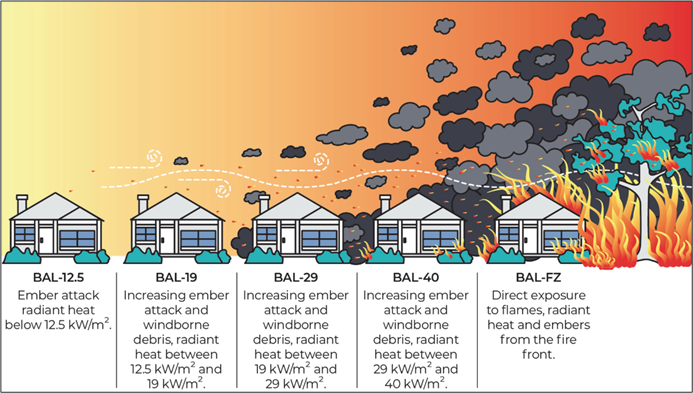
The BAL is a nationwide approach to determine the severity of a building’s potential exposure to ember attack, radiant heat and direct flame contact.
-
To find out the BAL for your property you will need to have a bushfire hazard assessment undertaken.
Given the technical nature of a BAL assessment, it is recommended that a suitably qualified person, with expertise in applying AS 3959-2018 undertake the assessment.
The Fire Protection Association Australia (FPAA) is the technical and educational fire safety organisation within Australia. FPA Australia administers the BPAD Accreditation Scheme, which was first developed and implemented in 2006 in response to demands for a recognition program for practitioners who help clients undertaking development on land subject to bushfire impact.
Accredited practitioners are recognised by industry, regulators, fire agencies, end-users, and the community as providers of professional bushfire assessment, planning, design, and advice services.
The Scheme provides an enhanced level of confidence that practitioners providing bushfire planning and design services are accredited by a suitably robust scheme that complies with government and community needs and is administered by the national peak body for fire protection.
-
In Victoria, the State Government has mapped designated bushfire-prone areas. Around 85% of the state is now classified as bushfire-prone, so there's a good chance your property is included, especially if you're in the Macedon Ranges or regional Victoria.
You can check whether your property is in a bushfire-prone area by:
Looking up your property on VicPlan (planning.vic.gov.au)
Calling us and we'll check for you
-
Class 1a: New residential homes, including detached houses, duplexes, and row housing.
Class 1b: Boarding houses, guest houses, hostels, or similar, that are small (usually less than 300m² and fewer than 12 people).
Class 2: Buildings containing two or more sole-occupancy units (e.g., apartment buildings, units).
Class 3: Residential buildings, such as motels, boarding houses, or residential parts of hotels.
Class 4: A residential unit within a building of another class (e.g., a caretaker's flat in a factory).
Class 9a & 9c: Health-care buildings (hospitals) and aged care facilities.
Class 9b: Schools, childcare centers, and early childhood centers.
Class 10a: Associated structures that are immediately adjacent or connected to the above classes, such as sheds, carports, and garages.
Associated Decks: Decks associated with the above buildings
-
The BAL is measured using levels of radiant heat, expressed in kilowatts per square metre. To put it more simply: the higher the number, the more severe the potential exposure.
The BAL is based on:
Your location. This will include how many directions a bushfire may approach from as well as road access in and out of the property.
The type of vegetation on your property. There is no such thing as fireproof vegetation as it can all burn in extreme fire conditions. The denser the vegetation, the more intense the fire zone is. If there is a mixture of trees, shrubs, grasses and leaf litter, this can have a kindling effect allowing the fire to build.
How far your house is from vegetation. The closer the property is to vegetation, the higher the fire risk. Research into Australian bushfires has indicated that around 85 per cent of house destruction happens within 100 metres of bushland.
The slope of your property. The topography affects the speed and spread of a fire. Fires burn faster uphill. The steeper the slope, the quicker the fire. When moving upslope, the fire dries out the vegetation ahead making it easier to burn. This is often a challenge, as some with to site a home at the top of a slope to maximise views.
In addition to ember attack, each BAL is based on heat flux exposure thresholds. BAL-LOW is the lowest risk category and there are no additional construction requirements for this category; and BAL-FZ (Flame Zone) is the highest risk category. description
-
Your BAL assessment will neeed to be submitted with your application for Building Permit.
Once a BAL rating is assigned, the plans of your building must include the relevant design features and notiations that must comply with AS 3959 construction standards for that level. These requirements may include:
Non-combustible roofing and wall cladding
Sarked and sealed roof spaces
Ember guards on vents, weepholes, and subfloors
Bushfire-rated shutters or metal mesh screens on windows and doors
Sealed gaps and joints to prevent ember entry
Subfloor enclosures using non-combustible materials
Additional setback or defendable space (Asset Protection Zones)
Is your property in the BMO?
Bushfire Management Overlay (BMO)
If your property is in the BMO, the requirements are more extensive. As well as a BAL assessment for your building permit, you'll likely need a bushfire management statement for your planning permit.
The BMO is heavily applied across the Macedon Ranges, particularly in areas like Woodend, Mount Macedon, Macedon, Riddells Creek, and parts of Romsey and Lancefield.